
How to Check Aspen Criminal History
First define the record. Aspen Police Records supplies APD incident reports and Aspen-only arrest histories. The municipal clerk holds city ordinance cases. Pitkin County Jail shows current custody, while Pitkin Combined Court holds cases filed under Colorado law. CBI supplies a statewide layer. Each office owns a distinct part of the record.
- Identify the arresting agency and gather the date, place, name, and case number.
- Use the APD form for a police report or local arrest history.
- Check Aspen Municipal Court for a city-code matter.
- Use Pitkin Jail and Combined Court for custody and state charges.
- Use CBI when a Colorado-wide self-review is needed.
Aspen Police Request Form
The online APD form asks for contact details, case number, incident date and time, location, involved parties, description, delivery choice, and a signed use agreement. It separates accident and case reports, APD arrest history, large criminal-history searches, photographs, video, body-worn camera files, and dispatch audio.
The current form lists accident reports, case reports, and APD arrest histories at $10. Five-or-more-case searches, media, body-camera files, and dispatch searches use other charges. Ask for an estimate before a broad audiovisual request.
The official request screen displays those choices.
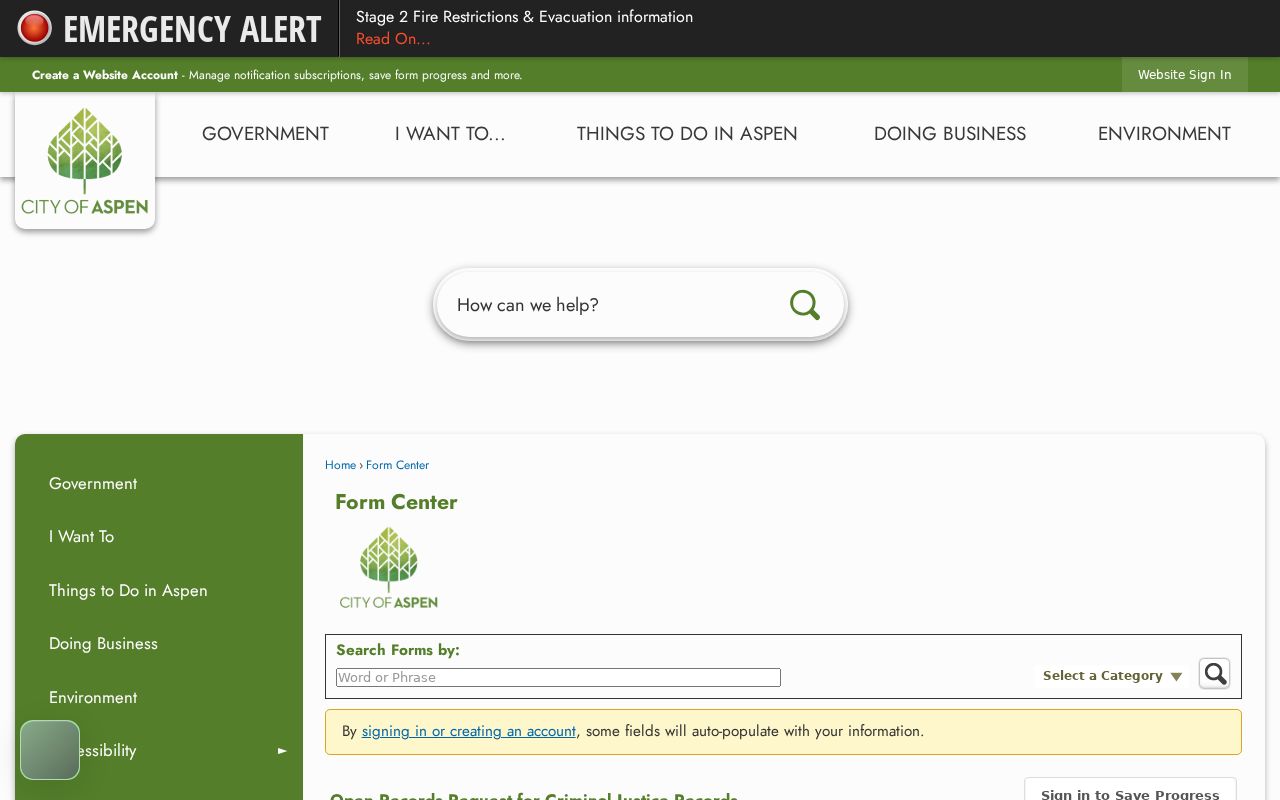
Choosing the narrow product helps APD locate and review the right record without an open-ended search.
The Aspen Police Department
Aspen Police Records serves incidents handled by APD within city limits. The unit is at 540 E. Main Street and can be reached at 970-429-1852 or PoliceRecords@aspen.gov, Monday through Friday from 8 a.m. to 5 p.m. CrashDocs handles accident reports; other records use the city form.
APD files do not become Sheriff reports when an arrestee enters Pitkin County Jail. Ask Aspen Police for its narrative, photos, dispatch audio, or body-camera file. Active investigations and protected details may be withheld or redacted.
Aspen Arrest History Is APD-Only
A $10 Aspen arrest-history response searches APD files only. It is not a countywide clearance and not a Colorado background check. A Sheriff, Basalt, Snowmass Village, or State Patrol arrest can be absent. Likewise, a Pitkin Sheriff letter can omit an APD arrest.
The Aspen records page defines the city channel.
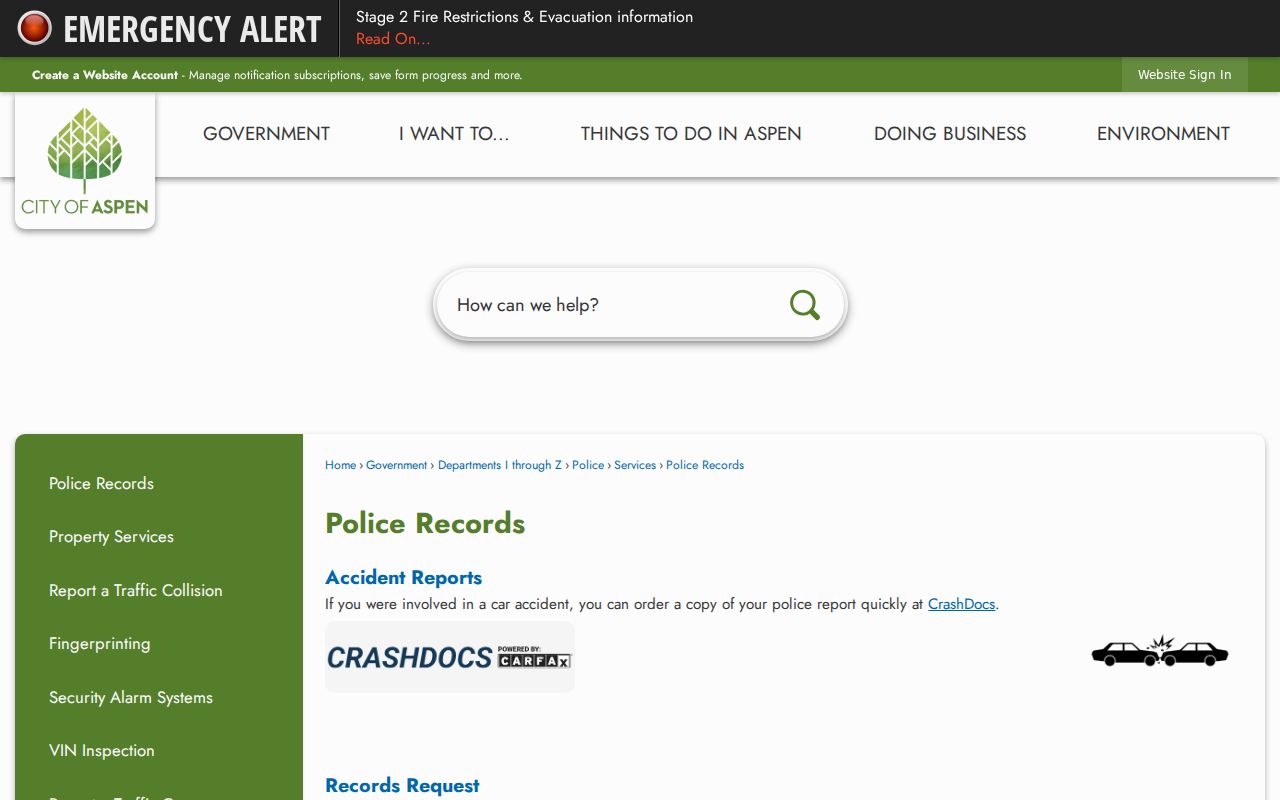
State the agency, name, and date range whenever describing a search result.
Arrests and Bookings in Aspen
APD arrestees are booked into Pitkin County Jail, not an Aspen city jail. The jail entry gives custody context; the police narrative stays with APD and the legal outcome belongs to the correct court. A citation and release can create an Aspen police record with no jail listing.
Current jail data is a snapshot. A released or transferred person may vanish from it. Match the APD number, booking date, court case number, and disposition. A booking allegation is not proof of guilt.
For a recent Aspen event, search in time order. Contact APD first when the incident narrative is the goal. Check the jail next if custody may still be active. Then look for the municipal or state case after filing has had time to occur. An APD arrest-history response and the jail list have different scopes: one searches city police files, while the other reports current county custody.
If the case appears in court but not in a Sheriff arrest letter, that difference can be normal. The Sheriff letter searches PCSO files and does not absorb Aspen Police arrests. Conversely, an APD response does not cover Sheriff activity. Attribute every result to the agency that ran it and never use either local product as a statewide certificate.
When the arrest and disposition disagree, obtain certified court papers. A filed charge can be amended or dismissed, and the booking label can remain as a historical description of intake. The court order explains the legal outcome. Preserve both numbers when asking APD, the clerk, or CBI to review a possible mismatch.
Aspen's Wednesday Court Calendar
The limited first-and-third-Wednesday schedule makes a call useful when the posted docket does not show whether a case was continued or closed. The clerk is available weekdays from 8 a.m. to 5 p.m. A posted docket is an index, not the full file.
The official Aspen court page provides current dockets and notices.
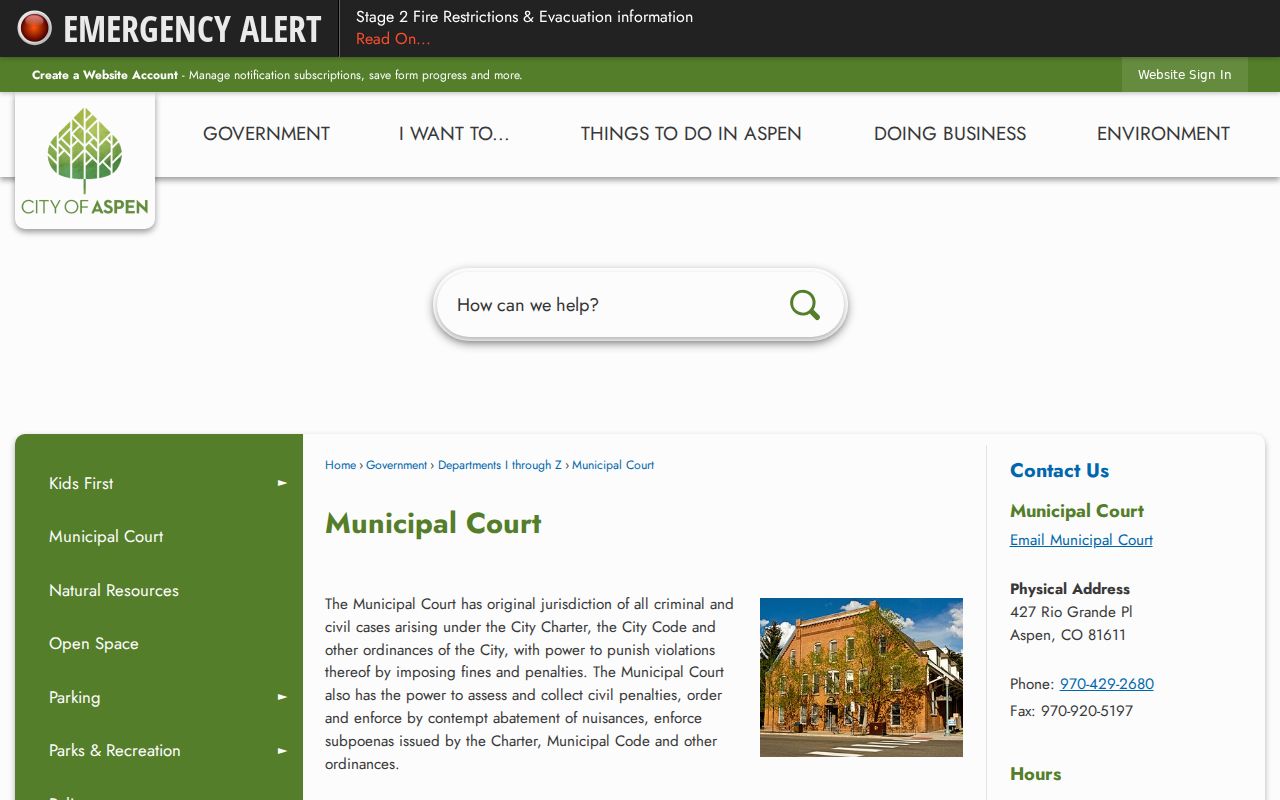
Use Combined Court for a state DUI or other Colorado charge even when APD made the arrest.
Aspen Municipal Court Records
Aspen Municipal Court hears City Charter, code, ordinance, and municipal traffic matters. Sessions occur first and third Wednesdays, plus a fifth when applicable, at 9 a.m. in City Hall. Call 970-429-2680 with the name, citation, and date.
| Court Name | Aspen Municipal Court |
|---|---|
| Case Types Heard | City code, ordinance, and municipal traffic matters |
| Case Lookup Channel | Posted docket, clerk phone, or City Hall counter |
| What the Docket Shows | Session, defendant or case, matter, time, and status |
| Copies & Fees | Confirm the current product and charge with the clerk |
Where Aspen Criminal Records End Up
Recent activity begins with APD. Filed state charges move to Pitkin Combined Court, while reportable arrest and disposition data may reach the state repository.
Record flow: Aspen Police › Aspen Municipal Court or Pitkin Combined Court › Colorado Bureau of Investigation
Use APD for the incident, jail for custody, the court for outcome, and CBI for broader Colorado self-review. Update timing differs across systems.
Aspen City or State Case
An ordinance citation can remain entirely at Aspen City Hall, while a DUI or other Colorado offense belongs in Pitkin Combined Court. The arresting agency does not decide this split by itself. Read the cited authority and ask the clerk which court received the filing.
If an Aspen matter has no Combined Court result, check Municipal Court before assuming no case exists. If it is a state charge, do the reverse. The Pitkin criminal court case process gives more depth on state dockets and dispositions.
Gather the citation, arrest paper, or jail receipt before calling. The printed authority, case number, and filing date can solve the routing question faster than a name alone. Ask whether the matter appears as municipal, County Court criminal, District Court criminal, or traffic. If several files share a name, request the number and status for each plausible match.
The compact Main Street justice corridor can make the custodians seem interchangeable. They are not. Aspen Police sits near the county courthouse, Sheriff, and jail, yet each office controls its own layer. Walking a request next door does not change ownership, disclosure rules, or the need to identify the correct file.
Aspen Resort Population Context
The Census estimated 6,489 Aspen residents in 2025, compared with 7,004 in 2020. Seasonal workers and visitors greatly change the daily population. A rate based only on residents can therefore distort the meaning of Aspen police activity. Use official agency-and-year figures and explain the denominator.
The Aspen Police department page supplies local agency context.
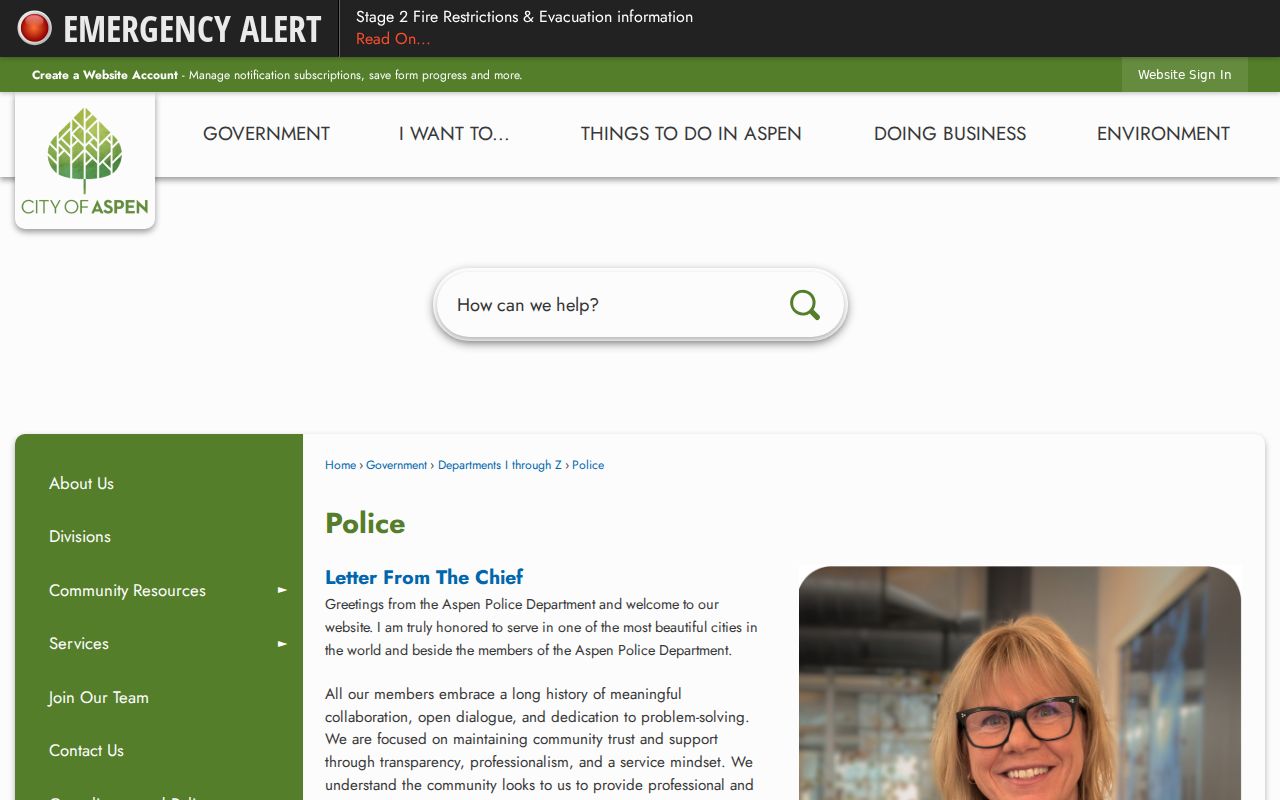
The city department remains custodian of APD reports despite the nearby county justice offices.
When Aspen Reports Are Redacted
Ask APD Records to identify the legal basis for a withheld passage. Sending the same request to PCSO will not produce an unredacted duplicate when APD owns the investigation. Narrowing the request by date, record type, and media can also separate releasable material from protected content.
For a wrong outcome, obtain the court disposition. Police records show the incident and arrest stage, while a dismissal, plea, verdict, or sentence comes from the court. Keeping those stages separate prevents an arrest label from being mistaken for a conviction.
Public Access Rules for Aspen Records
Colorado separates ordinary public records from criminal-justice files. CCJRA gives police custodians discretion over many APD records. Active investigations, juvenile files, victims, sealed cases, and protected data may be withheld or redacted.
Make the request precise. Identify a date range, location, APD case number, involved person, and the exact media sought. A report PDF, dispatch audio, photographs, and body-camera footage are separate products and can require different review work. Broad wording can raise research and redaction costs without improving the answer. Ask for a cost estimate and confirm how the city will deliver a large file.
Municipal court access follows a different track. The posted Aspen docket can identify a hearing, but a final order or full case file comes from the clerk. Sealed matters will not appear like ordinary public cases. When a short docket entry is unclear, request the underlying order rather than guessing what “disposition” means. It could reflect dismissal, plea, verdict, deferred result, or another termination.
Timing also matters. APD may finish its record review before a prosecutor files a state case, and a court disposition can reach the Colorado repository later still. Record the date each source was checked. A screen capture shows what a portal displayed then; it is not a permanent clearance. For self-correction, use stable identifiers and certified court papers when dealing with the office that owns the disputed entry.
Colorado adult relief is generally called record sealing, not expungement. A sealed Aspen matter can be restricted in public police, court, and repository views under the controlling order and statute. Juvenile expungement uses different rules. Neither APD nor a court clerk can choose a remedy for a requester, but each can explain its filing or access mechanics.
Key Statutes:
Colorado Open Records Act - governs many administrative records, not every police investigative file.
C.R.S. §§24-72-303 to 305.5 - control access to criminal-justice records.
C.R.S. §24-72-305.5 - restricts direct solicitation for pecuniary gain.